


I want to tell you about a moment I remember very clearly. I was further along in my corporate career, being quietly nudged towards a senior leadership role. People around me seemed to think it was the obvious next step. And from the outside, I suppose it looked like everything was going according to plan.
But then I looked upwards, to the group of people I was earmarked to join, and I saw black rings under their eyes from little to no sleep. And I saw people who spent long periods away from home and away from their families (actually…I was already that person). And I saw people who were expected to be permanently “on call” for the company, and I asked myself: “Is this how I want to spend my time?”
I’ve been thinking about that moment a lot lately, because I’m hearing versions of it from the people I coach. I’m hearing it from talented, high-performing professionals who are being groomed for leadership and quietly, privately, deciding they’d rather not. And I’m even hearing it from students who haven’t even entered the workforce – they’ve seen their parents have a specific type of career, and they don’t want it.
And then I read an article in the Sunday Times by Lyndy van den Barselaar, MD of Manpower South Africa, that gave a name to what I’ve been witnessing: a “leadership blackout.” Not a shortage of capable people. A shortage of desire. And I thought: yes. That’s exactly it.
(Here is the article - it’s behind a paywall, sorry!)
The most important thing van den Barselaar says in her article is this: the leadership pipeline isn’t empty. It’s opting out, and that is the real difference here, because it means the problem isn’t who we’re hiring or what skills we’re developing, and it’s what we’re actually asking people to step into.
In South Africa, where youth unemployment sits at 43.8% and 3.7 million people are classified as discouraged work-seekers, you’d think leadership roles would be flying off the shelf. But the data tells a different story. Younger professionals are watching the people above them, doing their sums, and concluding that the trade-off isn’t worth it. More pressure, more visibility, more emotional labour – for what? A title and a bigger inbox?
What I saw in the mines
I spent the better part of my career in the mining industry, a world that is, to put it gently, not known for its gentle approach to leadership. I went underground more times than I care to remember, built countless PowerPoint decks for bosses who got the credit, and did all the boots-on-the-ground things women are advised to do to gain credibility in a male-dominated industry. (I’m aware of how that sentence sounds. It sounds like 2003. Because it was.)
And I was good at it. Good enough that people started saying things like “I thought you were going all the way to the top.” Which is either a compliment or a warning, depending on how you look at it.
But here’s what I noticed, the closer I got to those senior positions: the people who occupied them were exhausted. Not the productive kind of tired you feel after a good day’s work, the other kind. The kind where you’ve been running on fumes for so long you’ve forgotten what it felt like to run on anything else. Back-to-back Teams calls. Rebuilding PowerPoint presentations to give management “better” numbers.
I had spent 880 weeks in that company. And at some point I looked up and thought: I just don’t want to play this game anymore.
I wonder how many of today’s younger professionals are having exactly the same thought, just earlier in the game than I did.
What the data is telling us
The ManpowerGroup “Human Edge” Trends Report backs this up with numbers that should be making every organisation sit up a little straighter. Here’s what stood out to me:
57% of workers globally have never had a mentor. In South Africa, where access to senior leaders is already limited by structure, geography and inequality, that number is almost certainly higher. Mentorship is how leadership potential gets spotted, nurtured and passed on. Without it, the path into leadership doesn’t just look hard, it looks invisible.
45% of South African Gen Z workers take on gig or short-term work on the side, nearly double the global average of 27%. In a market where youth unemployment sits above 43%, gig work isn’t a trend. It’s a survival strategy. And when the gig economy offers more autonomy, more flexibility and more sense of agency than a traditional leadership role, organisations are competing against a fundamentally different value proposition. And I haven’t even mentioned what AI is going to do to jobs and traditional corporate ladders (because I don’t know).
The traditional leadership contract: long hours, constant availability, emotional labour, limited support, was built for a world that no longer exists. It assumed stability and hierarchy and a clear path upward. Today’s leaders are expected to navigate economic volatility, rapid technology change, hybrid teams and rising employee expectations, often without the training or support to do any of it well.
(If you’re reading this Lyndy van den Barselaar, look here, I turned your article into a cool infographic):
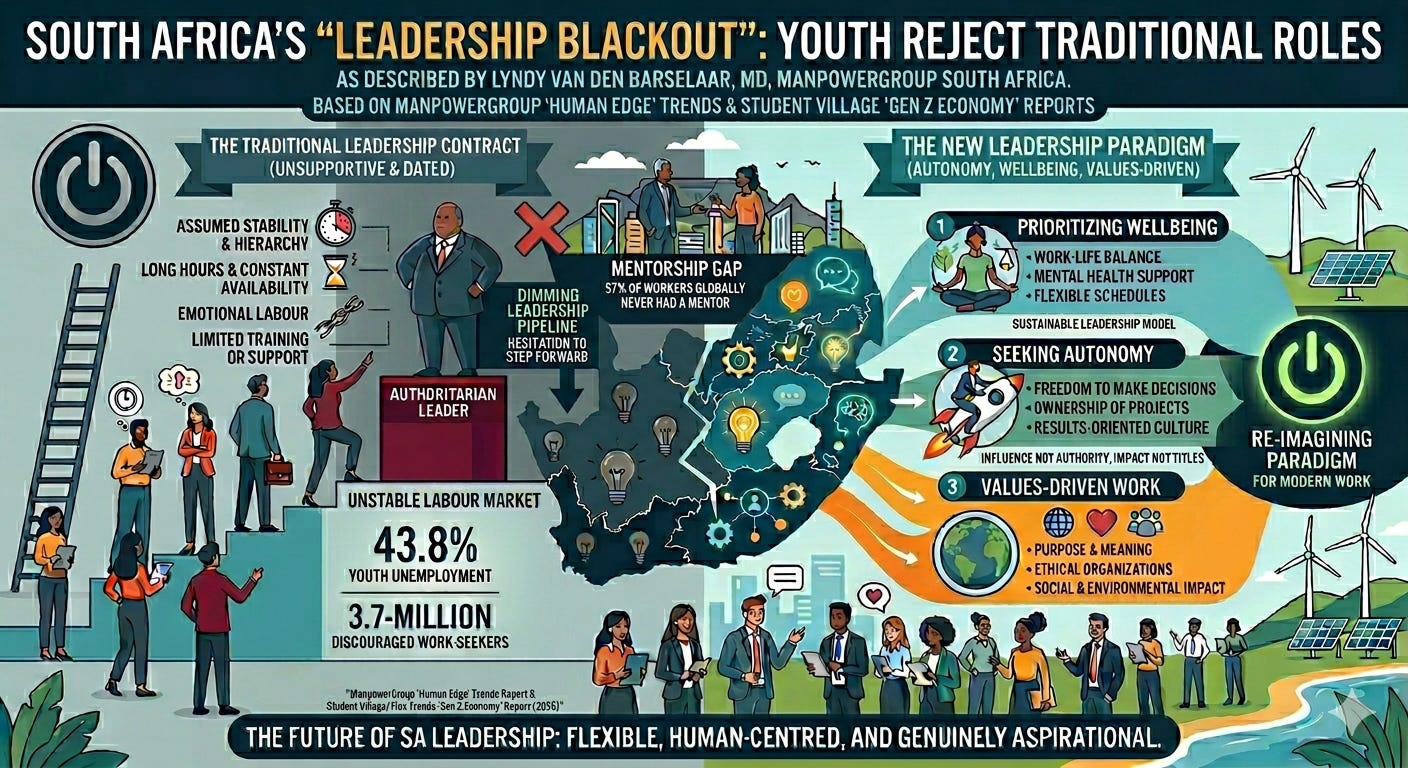
Source: Compiled from Lyndy’s article and ManpowerGroup “Human Edge” Trends Report & Student Village/Flux Trends “Gen Z Economy” Report (2025)
A coaching perspective: what’s really going on"?
I sit with this question a lot. Not from the outside, theorising about what “young people” want, but from inside coaching conversations, where the real answers tend to surface.And what I am hearing is not apathy but something that looks a lot more like a lack of clarity.
Younger professionals are watching their leaders closely. They’re seeing the toll it takes: the burnout, the isolation, the way people get promoted into roles that demand everything and offer very little back. And they’re making a very rational decision: no thank you.
What I keep hearing in my coaching conversations is that it’s not leadership itself they’re walking away from, it’s what leadership has come to look like in practice, and what it seems to cost the people who hold it.
From what I can see, there are four things younger professionals are really asking for, none of which the traditional leadership model reliably delivers:
Autonomy. Not the “you’re empowered to do exactly what we’ve already decided” kind. Real autonomy, the freedom to shape their work, make meaningful decisions, own something. Traditional leadership structures tend to give you more accountability while quietly removing your freedom. (Not exactly a compelling offer.)
Impact. They want to know their work matters. Tangibly, visibly, today, not in an annual report two years from now. Bureaucracy makes this feel impossible, and they know it.
Flexibility. The ability to work in a way that fits their lives, not a life structured entirely around work. The gig economy is winning here, and most organisations haven’t figured out how to apply this thinking to a traditionally corporate environment.
A path they can actually see. When 57% of workers have never had a mentor, leadership looks opaque and uninviting. If nobody shows you the way in and if nobody is genuinely invested in your growth, why would you put your hand up?
A recurring theme I see with young (30-40 year old) professionals is that they arrive at this place where they’ve got to the end of the blinkers-on climbing the ladder journey. They got the degree, then did the internship, then they were the graduate-professional, then junior-manager, then manager, and all of a sudden they lift their heads and look around and ask: “Is this what I really want?” And then the answer to that question catches them by surprise!
From a coaching perspective, this is actually healthy. It reflects a generation with a more integrated sense of self, one that doesn’t separate “professional achievement” from “personal wellbeing” the way many of us were conditioned to (and by us I mean us ancient gen-Xers). The problem isn’t their mindset. The problem is that our leadership models haven’t caught up.
So what does need to change?
Van den Barselaar’s article ends with a call to action for organisations, and I think it’s the right one. The leadership contract needs to be rewritten and genuinely reimagined.
For me, that starts with mentorship as a non-negotiable. Not the ad hoc, “if you’re lucky enough to find a sponsor who takes you under their wing” version. A structured, intentional practice that is taken as seriously as any other business process. The data is clear: without it, succession doesn’t happen.
It also means opening leadership pathways beyond formal qualifications. The gap between degree and non-degree holders is now the narrowest it’s been in 30 years. Skills (not credentials) should be driving succession decisions.
And if organisations want to compete with (or integrate) the gig economy, they need to start offering what the gig economy offers: autonomy, flexibility, and project-based ownership inside the organisation, not just outside it. Make leadership look like something worth choosing, not something worth enduring.
Most importantly, wellbeing needs to become a genuine leadership competency, not a poster on the wall or a wellness day in October.
South Africa is not running out of leaders. It is running out of reasons for people to want to become them.
I keep coming back to that moment I described at the beginning, the moment of looking at what leadership really costs, and deciding whether it was worth it.
My solution was to take a break and go for a walk in the Himalayas (because that’s how I roll). And after doing a lot of yoga and thinking and walking, I decided to redesign my life to be closer to who I am as a person. I discovered that I loved to help people take off the blinkers and find a way to be in the world in a way that feels more meaningful, so that’s what I do now.
The next generation is asking the same question I asked. They just have the self-awareness to ask it out loud, earlier. And that’s not a problem to solve. It’s an invitation to build something better.
Lots of love

If you’re navigating a leadership crossroads, whether to step up, step sideways or step out, I’m happy to think it through with you. Book a free 30-minute chemistry session here.