

I finally generated my PodStats report from the Solid Gold website this morning: eight years of podcast numbers, all laid out in neat little rows and graphics. I sat there with my coffee, not at all sure I wanted to open it. But, since I am a recovering geophysicist, and most of my corporate life was spent looking at data, I couldn’t resist. This report felt less like a spreadsheet and more like reading my own diary back to myself.
I never made On Change for the numbers. Some of you know I started it for an audience of one, a podcast aimed squarely at my manager-one-removed, in the hope that someone up the corporate ladder might notice I knew a thing or two about change.
I opened the report half-expecting vanity metrics, the podcasting equivalent of checking whether anyone liked your post. What I found instead was my own story, told back to me in listens.
And even though I don’t have the world’s most listened-to or most popular podcast, the data (presented in a couple of infographics below) showed me the value of having these conversations out there in the world: the podcast is giving my potential clients a glimpse of the type of person I am, the types of conversations that are important to me and whether they’d like to work with me.
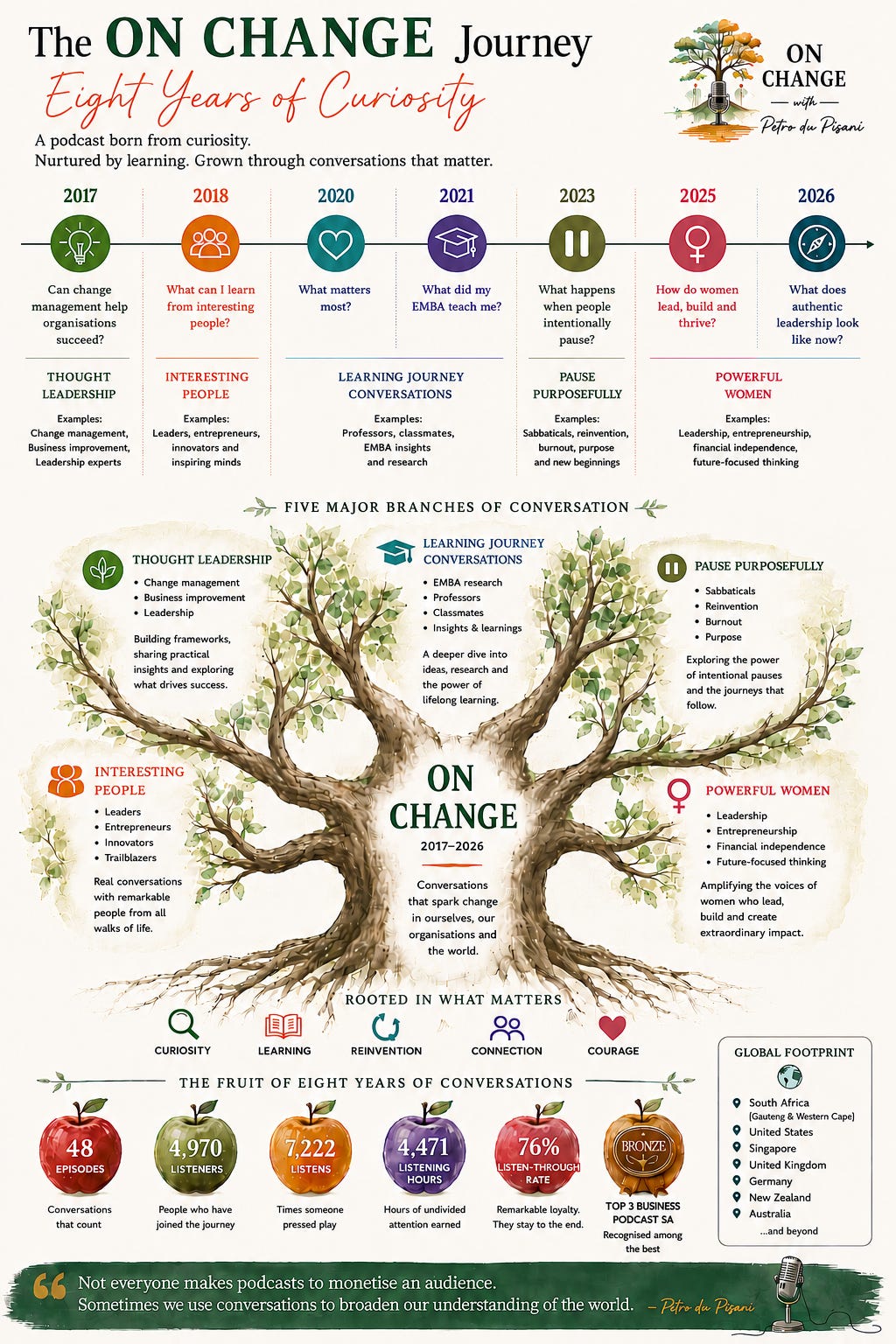
First, a word about where the numbers come from
Podcast data is a nightmare to pin down. Podcasts are decentralised by design, scattered across players and platforms that each count things their own way. A “listen” on one is not a “download” on another, which is not a “stream” on a third. Nobody agrees on the definitions, so nobody really holds the full picture.
Which is why what Gavin Kennedy and his team at Solid Gold Podcasts (the studio that has recorded On Change from the very start) have built is, as far as I know, fairly groundbreaking. They have stitched all of it together, not to crown themselves keeper of the One True Number, but to turn the mess into something you can actually learn from. As Gavin put it to me:
“Harvesting podcast data is by its very nature hard. And each platform uses different metrics and definitions of what a ‘listen’ is, and a ‘download’ vs. a ‘stream’. We’ve aggregated much of it, not to try be the font of definitive counts, but to use data for insights and ah-ha! moments. The exact counts matter when you’re selling the audience to advertisers. For REAL business though, understanding what gets listened to all the way through matters more.”
That last line turned out to be the whole story. What matters to me is what people stayed for, and the work my podcast was doing in the background to build credibility and trust.
It started as a work thing
The early episodes are so earnest that I want to go back and hug that version of Petro and tell her it will all turn out all right and she will find her way. Change management, safety culture, business improvement, reprogramming your brain, the power of storytelling. I asked the people who had taught me, the mentors, the interesting minds I bumped into at conferences.
Looking at it now, that first chapter was really just curiosity, dressed up as ambition. I told myself it was career strategy, and to an extent it was, but it turned out to be much more than that. It was laying the foundation for all the podcasts that were still to come, learning a new craft and getting better at asking questions that unlocked real insights.
Then I went back to school, and the show came with me
In 2020 I started my EMBA at UCT’s Graduate School of Business, and because we were forced on-line by the pandemic, I craved human connection, so I reached out to lecturers and classmates to hear their stories.
The conversations turned toward learning, purpose, authentic leadership and the joy of discovering how wonderful it was to be a student again in your forties.
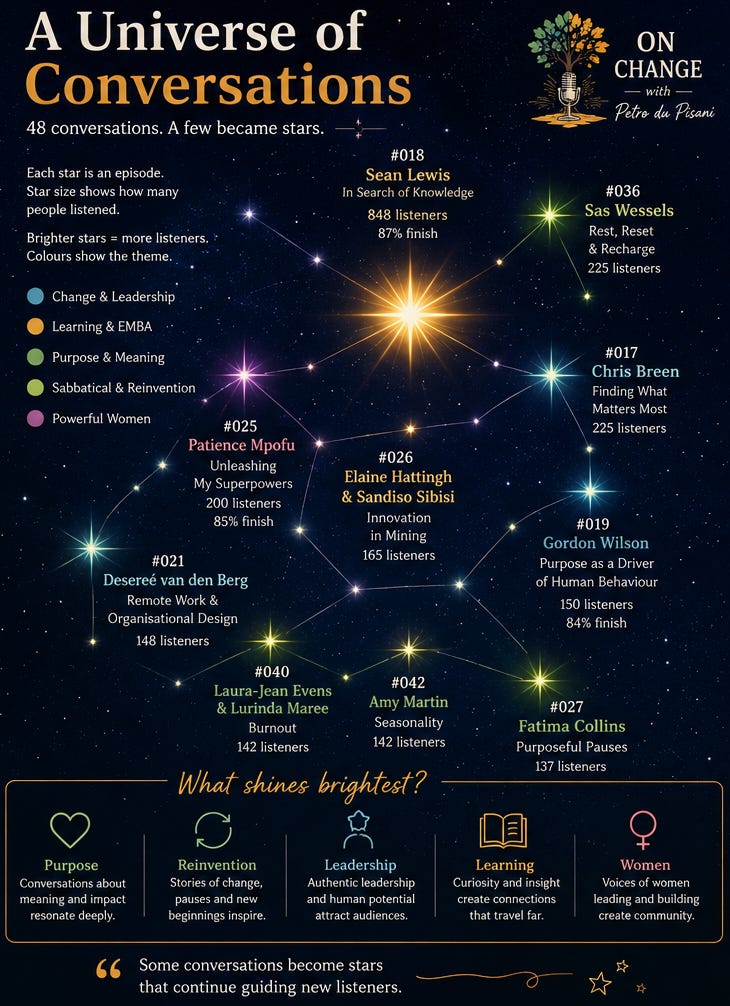
This is where the numbers surprised me. My episode with Sean Lewis, a conversation about systems thinking and evidence-based management, has been listened to by 848 people and more than four out of five of them stayed to the end of a 73-minute conversation…and some of them came back and listened again.
This is quite amazing! People tuned in and then stayed all the way until the end.
Chris Breen, talking about the classroom as a real-time laboratory for our own assumptions, also pulled a crowd. It turns out that when you are honestly trying to learn something in public, other people lean in and learn alongside you.
The infographic below provides some insights into the episodes that had the most listeners, and which topics listeners tuned in for: Purpose, Reinvention, Leadership and Learning.
The intentional pause that led to more stories
In 2023 all my time-to-leave-corporate plans came to fruition so that I could take a break from the rat race. Being me, I made a podcast about it. Sixteen episodes, from August 2024 through February 2025, all circling one idea: that rest is its own kind of strategy. Sabbaticals, reinventions, recoveries, career breaks taken for adventures, for healing from trauma, for furthering studies, or for recovering from burnout.
I didn’t realise until I saw the report that this was the single biggest body of work in the whole eight years. I was, quite literally, talking my way through my own pause by sitting with other people in theirs. And here is the part I love: a whole new audience found the show through these episodes. My older listeners still reach for the dense learning conversations, while a newer crowd, many of them on Spotify, came to On Change looking for rest and renewal and stayed for everything else.
Powerful women
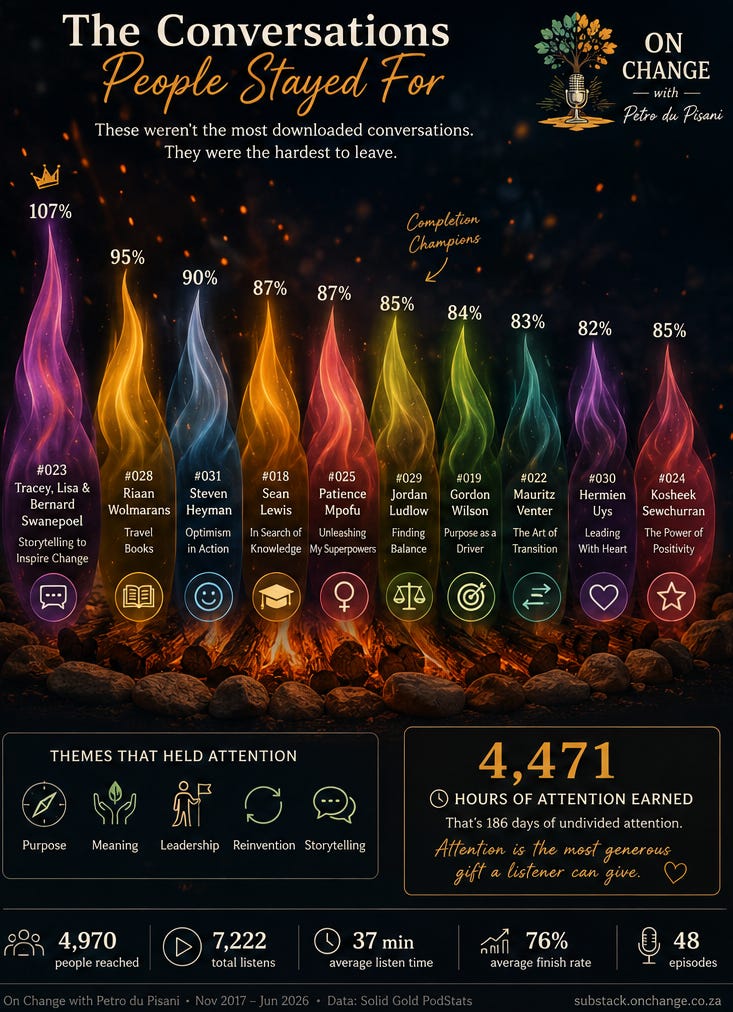
The most recent chapter is all about creating women role models. Real trailblazers: founders, climbers (physically and metaphorically), financial educators and accidental technologists. A woman who summited Everest at 53, the oldest South African woman to do so. A woman who built five businesses across three continents. An earlier episode with Patience Mpofu was the inspiration for a series of podcasts with powerful women. Patience had navigated the brutally male world of mining and written a book, Unleashing My Superpowers, and 85 out of every 100 people who started her episode finished it.
The Powerful Women series was no accident. By this point I had trained as a coach, I was building a coaching practice, and the people who mostly wanted to talk to me were women working out their own agency. The audience reflects it back: 55% of my listeners are women, and almost half are between 35 and 44, right in the thick of the working years where all of this stops being theoretical.
What the data really told me
If you map the whole thing out, the same roots keep feeding every branch: curiosity, learning, reinvention, connection, and a quality I can only call courage. For years I thought I was choosing topics, but as it turns out I was asking questions to make sense of the changes I was going through.
What I find mind-blowing is the 4,471 hours of human attention, given freely, by people from Gauteng to Singapore to a surprising number of Spotify listeners in New Zealand. And a 76% finish rate, which in podcast terms means people don’t drift off, they stay. Over eight years I’ve been having a long, slow, generous conversation with my tribe about things that are important to us.
The infographic below shows the episodes that had the best listen-through rates. This means that most people who pushed play, listened all the way to the end of the episode. And some came back and listened to the episode again; that’s how Tracey, Lisa & Bernard got a 107% listen-through rate.
For the nerds: Some excerpts from the actual report
If you’re a podcaster and you want to see what the actual report looks like, you can download it here. If your podcast provider is not giving you these types of insights, well, I know somebody who can ;-)
The report is full of insights that have now motivated me to keep going and keep seeking out meaningful conversations. Here are a few:
Listen-through: 76% listen-through rate is the clear signal your show delivers. That means three quarters of the people who start an episode stay until the end... or very close to it. In long-form conversation, where hosts earn trust through depth and authenticity 76% is exceptional proof that Petro du Pisani is saying things people genuinely want to hear.
People reached: 4,970 people have chosen to listen to On Change across five1 years. Think of that as a full conference of humans, all of them returning because the conversations matter.
Total listens: 7,222 times someone chose to press play. Each listen is a deliberate act. (7,222 times somebody chose to give me their attention)
Avg listen time: 37 minutes per listen. That is a full boardroom meeting, or a meaningful one-on-one conversation where real ground gets covered. Your audience is not sampling…they are settling in. That kind of sustained attention is where credibility is built, where ideas have room to breathe, and where a host’s authority compounds with every conversation.
Hours/day: 2.3 hours per day, on average, across the entire five-year window. That is the consistent daily drumbeat of people tuning in. (That’s 2.3 hours of meetings I don’t have to have each day)
So, there you go: I might not have the biggest podcast out there, but this data means everything to me. I am so grateful for each person who pushed play and chose to spend time with me and my podcast guests.
From the bottom of my heart: Thank You!
Lots of love

Thank you to Solid Gold Podcasts for recording, editing and publishing the On Change Podcast. And thank you for the insights.
The data is only from 2021, even though the show has been going since 2017.
I love listening to your podcast - the conversations are always so interesting, and even when I think they may not be that related for me there is always some little gem hiding in them that I walk away with! Keep up the good work!